A treatment option for
infantile hemangioma.
The first and only FDA-approved treatment for proliferating infantile hemangioma requiring systemic therapy.
The discovery of propranolol in the treatment of infantile hemangioma.
In 2007, while treating a baby for infantile hemangioma with oral steroids, the baby presented a cardiomyopathy (a complication of this treatment). Therefore, the child was treated with propranolol. Dr. Christine Léauté-Labrèze and her colleagues discovered that propranolol hydrochloride (the active ingredient in HEMANGEOL) could also control the growth of hemangiomas.
This discovery prompted a randomized, controlled clinical trial to investigate the safety and efficacy of propranolol hydrochloride (HEMANGEOL) for infantile hemangioma, with the goal of developing a pediatric formulation and strength that met regulatory guidelines and requirements, including the European Medicines Agency (EMA) and U.S. Food and Drug Administration (FDA).2,3
Clinically proven safety and effectiveness profile.
6 out of 10 babies on HEMANGEOL had their infantile hemangioma lesion “completely or nearly completely resolved” by 6 months of therapy versus only 4% of babies who received no treatment (n=101).1
*Of patients on HEMANGEOL 3.4 mg/kg/day for 6 months who were considered successes, 10% required retreatment for recurrence of hemangiomas.
Nearly 9 out of 10 of the babies treated with HEMANGEOL showed improvement by 5 weeks, compared with 5% of babies who received no treatment (n=55)2.
*Based on independent-investigator assessment of telangiectasis, color, textural change, and distortion of anatomical landmarks or skin contours compared to baseline.
Less than 2 of 100 babies given HEMANGEOL had to stop treatment due to adverse experiences, reflecting a well-established safety profile in infants.1
The most common side effects (>10%) were sleep problems, worsening respiratory tract infections, diarrhea, and vomiting — most were mild and manageable with your doctor’s guidance.1
HEMANGEOL can cause serious side effects, including low blood sugar (hypoglycemia), especially if the patient is not taking feedings, or is vomiting.
Please read additional Important Safety Information for HEMANGEOL.
Complete or nearly complete resolution after 6 months of therapy.
Statistically significant response was shown in patients (5 weeks to 5 months of age with proliferating infantile hemangiomas) treated with HEMANGEOL versus placebo.
In a pivotal Phase II/III clinical trial (n=460), 4 regimens of propranolol hydrochloride were compared: 1.2 or 3.4 mg/kg/day in twice daily divided doses for 3 or for 6 months as compared to placebo. Among patients treated with HEMANGEOL 3.4 mg/kg/day for 6 months:
Complete or nearly complete resolution of IH at Week 24
P<0.0001
60% of infants receiving HEMANGEOL (n=101)1 vs. 4% of those in the placebo group met the primary endpoint of complete or nearly complete resolution of infantile hemangioma (P<0.0001).
10% of successful patients at week 24 required retreatment of their infantile hemangioma.
Life-threatening infantile hemangioma, function-threatening infantile hemangioma, and ulcerated infantile hemangioma with pain and lack of response to simple wound care measures were excluded.
88% of patients on HEMANGEOL showed improvement of infantile hemangioma after 5 weeks of treatment* (n=55).2
*Of patients on HEMANGEOL 3.4 mg/kg/day for 6 months who were considered successes, 10% required retreatment for recurrence of hemangiomas.
*Based on independent-investigator assessment of telangiectasis, color, textural change, and distortion of anatomical landmarks or skin contours compared to baseline.
Second open-label clinical study (n=23).
Target lesions resolved by 3 months in 36% of infants with proliferating infantile hemangioma, including:
- Function-threatening infantile hemangioma
- Infantile hemangioma in certain anatomic locations that often leave scars or deformity
- Large facial infantile hemangioma
- Smaller infantile hemangioma in exposed areas
- Severe ulcerated infantile hemangioma
- Pedunculated infantile hemangioma
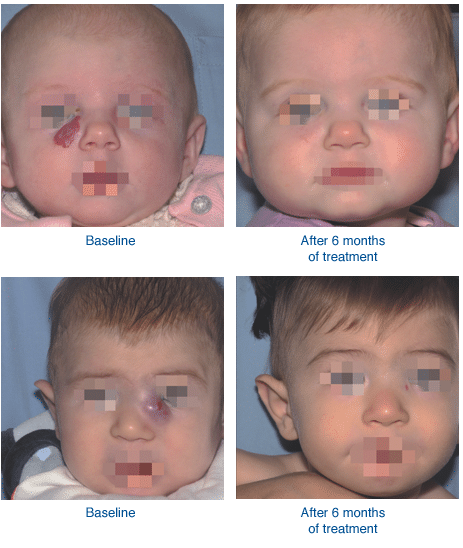
Before and after HEMANGEOL treatment.3
Safety profile.
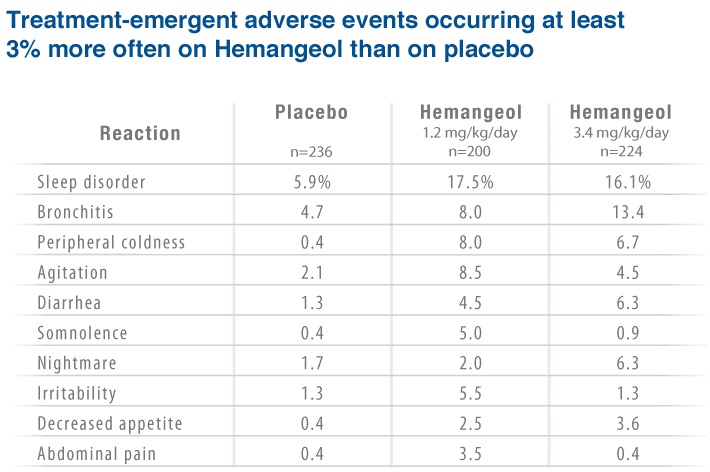
Adverse Reactions and Events.1
The most frequently reported adverse reactions (≥10%) in infants treated with HEMANGEOL were:
- Sleep disorders
- Aggravated respiratory tract infections such as bronchitis and bronchiolitis associated with cough and fever
- Diarrhea
- Vomiting
The following adverse events were observed with an incidence of less than 1%:
- Cardiac disorders
- Decreased blood glucose
- Decreased heart rate
- Urticaria
- Alopecia
Fewer than 2% of treated patients discontinued treatment due to adverse reactions.
Contraindications.1
- Premature infants with corrected age <5 weeks
- Infants weighing less than 2 kg
- Known hypersensitivity to propranolol or any of the excipients
- Asthma or history of bronchospasm
- Heart rate <80 beats per minute, greater than first degree heart block, or decompensated heart failure
- Blood pressure <50/30 mmHg
- Pheochromocytoma
Warnings and Precautions.1
Hypoglycemia
HEMANGEOL can cause hypoglycemia at any time during treatment. Risk is increased during fasting (e.g., poor oral food intake, infection, vomiting) or when glucose demands are increased. Withhold the dose under these conditions. Discontinue HEMANGEOL if hypoglycemia develops and treat appropriately.
Bradycardia and Hypotension
HEMANGEOL may cause or worsen bradycardia or hypotension. In studies the mean decrease in heart rate was about 7 bpm with little effect on blood pressure. Monitor heart rate and blood pressure after initiation or dose increase.
Bronchospasm
HEMANGEOL can cause bronchospasm; do not use in patients with asthma or a history of bronchospasm. Interrupt treatment in the event of a lower respiratory tract infection associated with dyspnea and wheezing.
Cardiac Failure
Sympathetic stimulation supports circulatory function in patients with congestive heart failure; beta blockade may precipitate more severe failure.
Increased Risk of Stroke in PHACE Syndrome
By dropping blood pressure, HEMANGEOL may increase the risk of stroke in PHACE syndrome patients with severe cerebrovascular anomalies. Investigate infants with large facial infantile hemangioma for potential arteriopathy associated with PHACE syndrome prior to therapy.
Hypersensitivity
Beta-blockers will interfere with epinephrine used to treat serious anaphylaxis.

 View the full article on jaad.org
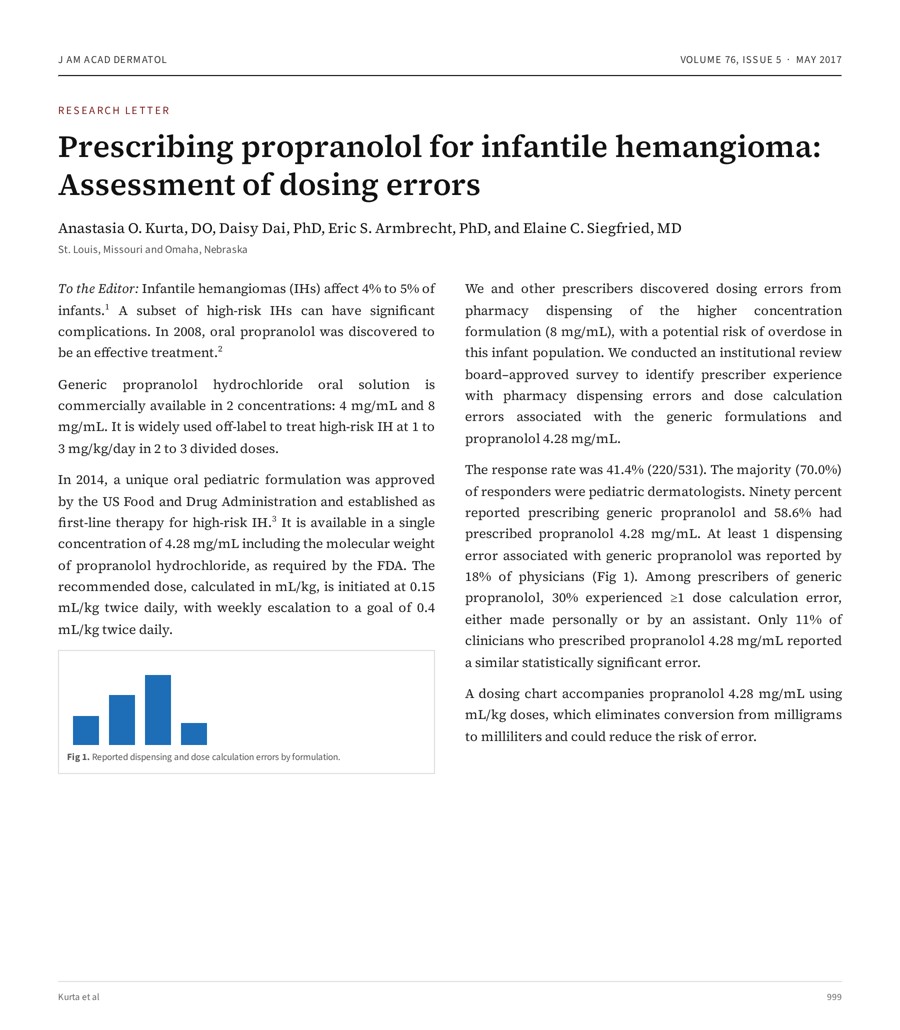
Dosing errors for HEMANGEOL vs generic propranolol hydrochloride.
In 2017, the Journal of the American Academy of Dermatology published a letter to the editor, "Prescribing propranolol for infantile hemangioma: Assessment of dosing errors," showing results from an institutional review board–approved survey comparing the propensity for dispensing and dosing calculation errors of HEMANGEOL (propranolol hydrochloride oral solution 4.28 mg/mL) versus generic propranolol hydrochloride oral solutions (4 mg/mL and 8 mg/mL) during the treatment of infantile hemangiomas.
The survey of 220 pediatric dermatologists and other physicians who treat infantile hemangioma found that medication dispensing and calculation errors are very common among physicians prescribing generic propranolol hydrochloride vs. HEMANGEOL.
Article Source: https://www.jaad.org/article/S0190-9622(16)31183-5/fulltext
References
Prescribing errors with pediatric oral propranolol solutions. Reactions Weekly 1651, 12 (2017). https://doi.org/10.1007/s40278-017-29824-x
Ready to refer a patient?
References
- HEMANGEOL [Prescribing Information]. Eton Pharmaceuticals, Inc.
- Léauté-Labrèze C, Hoeger P, Mazereeuw-Hautier J, et al. A randomized, controlled trial of oral propranolol in infantile hemangioma. N Engl J Med. 2015;372:735-746. nejm.org
- Leaute-Labreze, Frieden I, Voisard J. Propranolol in infantile hemangiomas: results from an international double-blind, randomized, placebo controlled, multidose, adaptive phase 2/3 study. Presented at: AAD 71st annual meeting March 1-5 2013, Miami, FL.